> For the complete documentation index, see [llms.txt](https://notes.theditor.xyz/llms.txt). Markdown versions of documentation pages are available by appending `.md` to page URLs; this page is available as [Markdown](https://notes.theditor.xyz/time-complexity.md).
# Time Complexity
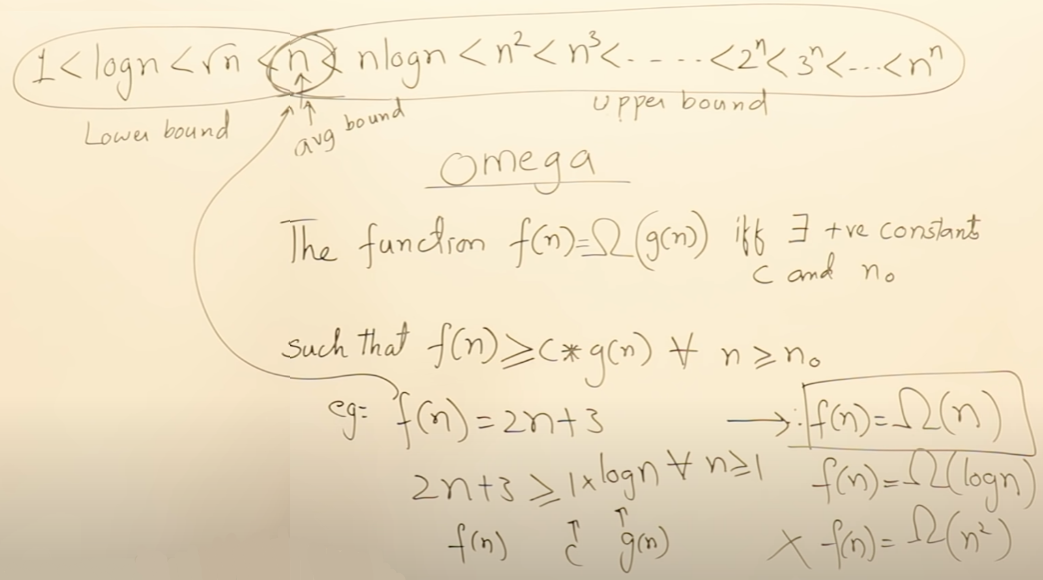
## Asymptotic Notations
1. Big oh - $$O$$ - Upper bound - $$f(n) = O(g(n))$$ iff $$f(n) \le c \cdot g(n)$$ - Any higher/equal order function than average case
2. Big omega - $$\Omega$$ - Lower bound - $$f(n) = \Omega(g(n))$$ iff $$f(n) \ge c \cdot g(n)$$ - Any lower/equal order function than average case
3. Theta - $$\theta$$ - Average bound - $$f(n) = \theta(g(n))$$ iff $$c\_1 \cdot g(n)\le f(n) \le c\_2 \cdot g(n)$$
{% hint style="info" %}
Since $$\theta$$ gives most accurate bound of a function, it is preferred over $$O$$ and $$\Omega$$ which are boundless.
Note: These aren't linked with best case or worst case scenarios, these are just notations. Worst case and best case can be shown using any of these notations.
{% endhint %}
Big Oh
Theta
Big Omega
### Properties
Property
O
Ω
θ
Reflexive
true
true
true
Transitive
true
true
true
Symmetric
false
false
true
Transpose Symmetric
true
true
false
{% hint style="info" %}
Transpose Symmetric is if $$f(n) = O(g(n))$$ then $$g(n) = \Omega(f(n))$$
{% endhint %}
## Comparing Functions
* Functions can be directly compared, however, two functions can be of same complexity (asymptotically equal) even if their constants are unequal. Natively constants **do not** hold significance in comparing functions.
* If two functions cannot be directly compared (i.e. powers exist), logarithms can be used to compare such functions, however, when taking logarithm - any constants generated by application of logarithm **DO HOLD** significance and hence after application of logarithm, two functions cannot be asymptotically equal if they have differing constant coefficients.
{% hint style="info" %}
Examples
1. Functions $$2n^{\sqrt n}$$ and $$3n^{\sqrt n}$$ are asymptotically equal.
2. Functions $$2^{2n^{\sqrt n}}$$ and $$2^{3n^{\sqrt n}}$$ are **NOT** asymptotically equal, even though on application of logarithm it produces the same functions as in Example 1.
{% endhint %}
## Big O Cheat Sheet
bigocheatsheet.com
## Calculating complexity
1 sec = $$10^8$$ operations (approx.)
#### Example
Time constraint: 20 seconds
$$0 < n \le 2 \times 10^5$$
Here to find out the time complexity, consider $$n^2 = 4 \times 10^{10}$$ which would equal to `400 seconds`. Hence, time complexity here should be less than $$O(n^2)$$.